
Exchange control and offshore trading
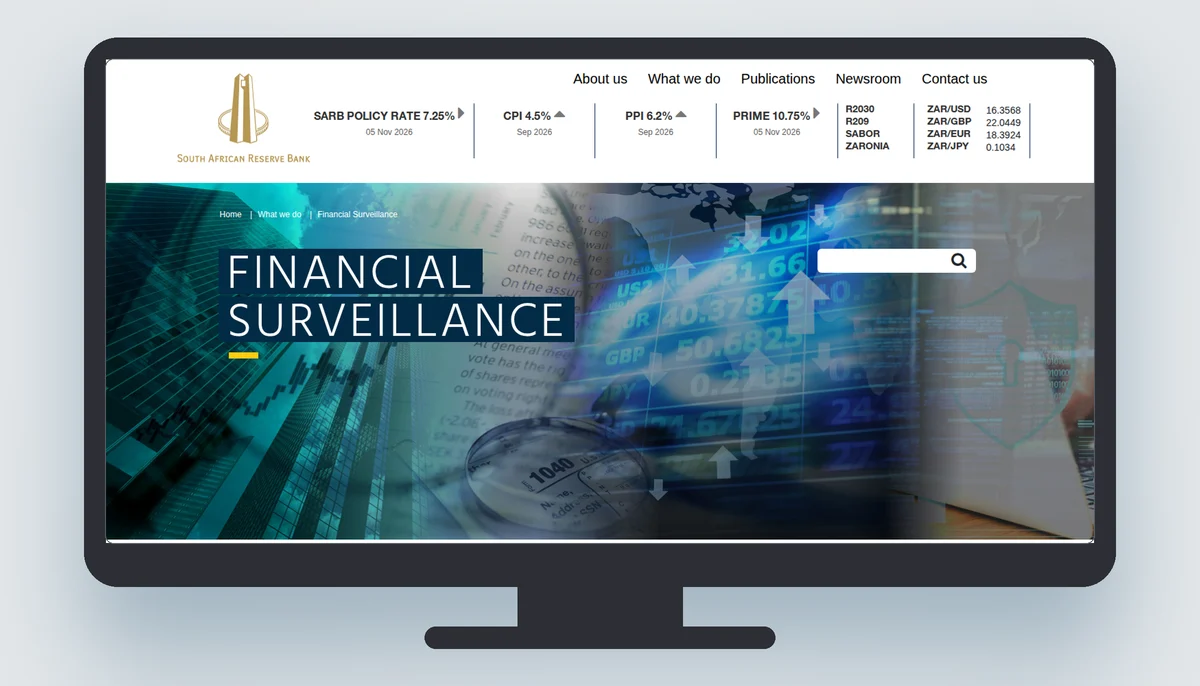
Key facts
South African exchange control applies when money leaves the country. Individuals have allowances for sending money abroad, tax-compliance status is required for larger amounts, and the Reserve Bank's Financial Surveillance department is the authority. Confirm the current rules with an authorised dealer, usually your bank.
Who administers exchange control
Exchange control in South Africa is administered by the South African Reserve Bank's Financial Surveillance department. The rules are set out in the Currency and Exchanges Manual. Authorised dealers, which are usually banks, implement the rules for individuals.
The bank is the reader's first point of contact. The bank checks the transaction against the allowances and can require a tax compliance status PIN from SARS for larger amounts. The rules change, so the reader should ask the bank for the current position.
Allowances for individuals
Individuals have allowances for sending money abroad. There is a single discretionary allowance and a foreign investment allowance. The amounts change from time to time. This site does not publish amounts because they can change and because a reader's circumstances affect what applies.
The bank will tell you which allowance applies to your transaction and how much you can send. The bank will also tell you what documents you need. Do not rely on a figure you saw on a website; confirm with the bank.
Tax compliance status for larger amounts
For larger amounts, the bank will require a tax compliance status PIN from SARS. This confirms that your tax affairs are in order. The bank cannot process the transfer without it. The PIN is obtained from SARS through eFiling.
The threshold for requiring a PIN changes. The bank will tell you if you need one. Do not try to split a transfer into smaller amounts to avoid the requirement; that is unlawful and the bank will detect it.
Crypto and exchange control
Buying crypto from a local provider with rand does not involve exchange control, because the money does not leave the country. Sending rand to an offshore exchange or broker to buy crypto or trade CFDs does involve exchange control. The transfer must go through an authorised dealer.
If you use a credit or debit card to buy crypto offshore, the transaction is still subject to exchange control. The card issuer will apply the rules. You cannot avoid exchange control by using a card.
What to ask the bank
Ask the bank what allowance applies to your transfer, what documents you need, and whether you need a tax compliance status PIN. Ask about the purpose of the transfer. The bank must record the purpose, and it must be accurate.
Ask about the fees and the exchange rate. The bank will convert your rand to the foreign currency at its rate. The rate is not published in advance; it is set at the time of the transaction. Compare the rate with other banks if you wish.
Offshore trading accounts
An offshore trading account is an account with a broker outside South Africa. To fund it, you must send money offshore through the bank, using your allowance. The broker does not handle the exchange control; the bank does.
The broker will ask for your country of residence and may require documents. The broker is not responsible for your exchange control compliance. You are. If you send money without using the bank's process, you are breaking the law.
The offshore platform's own bank is outside South African exchange control
When money leaves South Africa, it enters another country's banking system, and that country's rules apply to the platform. South African exchange control stops at the border; it does not follow the money to the offshore broker's account. The platform may be regulated in its home country, but that regulation is not a South African licence. A reader who assumes that a foreign regulator's approval satisfies South African requirements is making a category error.
The Reserve Bank does not approve or disapprove of specific offshore trading platforms. Its role is to control the outflow of money, not the quality of the destination. A platform can be perfectly legal in its own jurisdiction and still be a place where a South African loses money through bad trading. The reverse is also true: a platform that no South African authority has heard of may be legitimate, but the reader has no local record to check. The absence of a South African register for offshore platforms is a fact of the system, not a gap this site can fill.
When a platform tells a South African client that it is 'fully compliant', the statement may refer only to the platform's home regulator. It does not mean the South African Reserve Bank has blessed the arrangement. The reader who wants to check the platform's status must look to the foreign regulator's register, and even then, that register says nothing about South African exchange control. The two systems are separate, and a clean bill abroad does not make the transfer legal from South Africa.
The allowance is per person, not per platform
A common misunderstanding is that the amount a South African may send offshore resets for each trading platform used. The allowance is per natural person per calendar year, regardless of how many platforms receive money. If you send half the allowance to one offshore broker and half to another, you have used the full amount. The bank tracks the total across all transfers, not per destination.
This matters when a reader opens accounts with several platforms, perhaps to test them. The bank's record is cumulative, and the bank may refuse a transfer that would push the total over the limit. The reader who plans to use multiple platforms must keep track of the sum sent, because the bank will not warn in advance. It is not the platform's job to know how much you have already sent; that is between you and the bank.
There is also no carry-over of unused allowance from one year to the next. What is not used is simply gone. A reader who waits until December to send money for trading may find that the bank cannot process the full amount if the annual limit is reached. The practical consequence is that timing matters: sending money earlier in the year leaves room for later transfers, while leaving it late risks a blocked transaction.
Buying crypto with rands on a South African exchange is not an offshore transfer
Many South Africans assume that because crypto is global, buying it locally involves exchange control. If you buy crypto from a South African exchange using rands, and the crypto stays on that exchange or in your own wallet, no money has left the country. Exchange control applies to the movement of money across borders, not to the asset you buy. The Reserve Bank's rules are about currency outflow, not about what you hold.
The distinction becomes important when you later send that crypto to an offshore exchange or wallet. At that moment, the crypto is treated as an asset leaving South Africa, and exchange control may apply to its value. The bank will not see the crypto transfer; it only sees the original rand payment to the local exchange. But if you later sell the crypto offshore and bring the proceeds back, the bank will ask how the money was earned. The trail matters.
A reader who buys crypto locally and then sends it to an offshore trading platform has not used any of the foreign investment allowance at the time of purchase. The allowance is used only when rands are converted to foreign currency and sent abroad. If the crypto is sent abroad and sold there, the proceeds are foreign currency, but the original rand never left through the banking system. This creates a gap that the bank may question on repatriation.
The tax compliance status PIN is not a once-off clearance
A tax compliance status PIN from SARS is required for certain foreign transfers, but it is not a permanent licence to send money offshore. The PIN is valid for a limited period and for a specific purpose, and the bank checks it at the time of the transaction. A reader who obtained a PIN months ago for a different transfer cannot assume it will be accepted today. The bank's system verifies the PIN against SARS in real time.
The PIN also does not mean that SARS has approved the offshore trading activity. It means only that your tax affairs are in order as far as SARS can see. The trading itself may still have tax consequences when you eventually bring profits back or when you declare your worldwide income. The PIN is a snapshot, not a ruling, and it says nothing about the legality of the platform you use.
If the bank rejects a PIN, the usual reason is that it has expired or that it was issued for a different category of transfer. The reader must go back to SARS and apply for a new PIN for the correct purpose. This is a procedural step, not a penalty, but it can delay the transfer by days. The practical lesson is to obtain the PIN only when you are ready to send the money, not as a general preparation.
Sending money to a foreign bank account in your own name still uses the allowance
Some readers believe that if they send money to their own offshore bank account and then use that account to fund a trading platform, the transfer is not an investment. The bank's classification depends on the purpose stated when the money leaves South Africa. If the purpose is 'foreign investment' or 'trading', the allowance applies. If the purpose is a gift or a loan, different rules apply, and the bank will ask for evidence.
The fact that the money goes to your own account abroad does not make it exempt. Exchange control looks at the reason for the transfer, not the ownership of the destination account. A transfer to your own account for the purpose of trading is still a foreign investment. The bank will record it as such, and the amount counts against your annual limit just as if you had sent it directly to the platform.
This matters when a reader tries to split a larger amount into smaller transfers to avoid scrutiny. The bank's systems aggregate transfers over time, and the pattern may trigger a request for explanation. Structuring a transfer to stay under a threshold is not permitted, and the bank can refuse the transaction or report it. The clean approach is to state the true purpose and let the bank apply the correct rule.
The Reserve Bank's rules change without a public register
Exchange control is administered through circulars and rulings issued by the Reserve Bank's Financial Surveillance department. These are not published in a single public register that a reader can consult like the FSCA's list of licensed providers. Instead, the bank's authorised dealers receive the updates and apply them. A reader who wants to know the current allowance must ask the bank, not rely on a website that may be out of date.
This site deliberately does not publish figures for allowances, because the figures change and because a reader's personal circumstances affect what applies. A published number would create a false sense of certainty. The same is true for the tax compliance threshold: it is set by SARS and can change without notice. The only reliable source is the bank at the time of the transfer, and the bank's answer is binding for that transaction.
The absence of a public register also means that a reader cannot check a platform's compliance with exchange control by looking at any list. The platform may claim to be 'SARB approved', but the Reserve Bank does not approve platforms. The claim is meaningless, and the reader should treat it as a red flag. The only entity that can approve a transfer is the authorised dealer, and that approval is per transaction, not per platform.
Next on the decision map
Crypto and licence questions
What is exchange control?
Exchange control is a set of rules that governs the flow of money in and out of South Africa. It is administered by the South African Reserve Bank. Individuals must use authorised dealers, usually banks, to send money abroad.
How much can I send offshore?
There are allowances for individuals. The amounts change, and your circumstances matter. Ask your bank. Do not rely on figures from websites.
What is a tax compliance status PIN?
It is a PIN from SARS that confirms your tax affairs are in order. The bank requires it for larger transfers. You get it from SARS eFiling.
Does buying crypto offshore involve exchange control?
Yes. Sending money to an offshore exchange or broker to buy crypto or trade CFDs is an outward transfer. It must go through the bank's process.
What if I use my credit card to buy crypto offshore?
The transaction is still subject to exchange control. The card issuer applies the rules. You cannot avoid exchange control by using a card.
An offshore CFD account, checked against the same questions
This site links to an account with FxPro, an international broker offering CFDs on currencies, metals, indices, shares and crypto. Opening an account means agreeing to a client agreement with a specific regulated entity; read that agreement and the risk warning before you deposit. CFDs are leveraged and can lose your money quickly.