
Licensed crypto asset service providers
Key facts
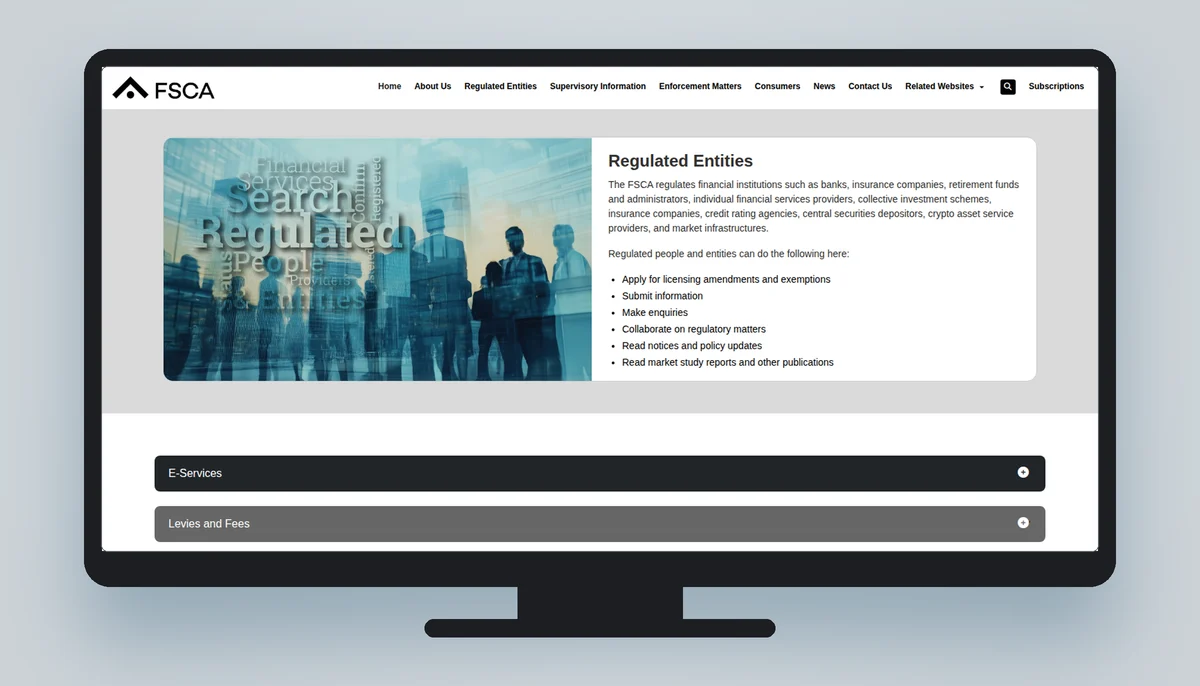
Crypto assets are a financial product in South Africa. A business that advises on or sells them needs a licence as a financial services provider. The table above shows entries from the FSCA's register of authorised providers, read once a week. A row records what the source published, not a finding of ours.
Crypto asset service providers on the FSCA register
The provider's name as listed and the licence category.
| Provider as listed by the FSCA | List dated | Licence category | Source |
|---|---|---|---|
| Category I (advice and intermediary services) | |||
| Azanvest (Pty) Ltd | 04.2024 | Category I | FSCA ↗ |
| Capta Forex (Pty) Ltd | 04.2024 | Category I | FSCA ↗ |
| Capta Wealth (Pty) Ltd | 04.2024 | Category I | FSCA ↗ |
| Centric Wealth Advisory (Pty) Ltd | 04.2024 | Category I | FSCA ↗ |
| Crypto Villa (Pty) Ltd | 04.2024 | Category I | FSCA ↗ |
| Duepoint Network Consultants (Pty) Ltd | 04.2024 | Category I | FSCA ↗ |
| Epic Life Financial Services (Pty) Ltd | 04.2024 | Category I | FSCA ↗ |
| Exclusive Advisory Services (Pty) Ltd | 04.2024 | Category I | FSCA ↗ |
| Expansion FX Markets (Pty) Ltd | 04.2024 | Category I | FSCA ↗ |
| Fairbairn Consult (Pty) Ltd | 04.2024 | Category I | FSCA ↗ |
| FV Of Money (Pty)Ltd | 04.2024 | Category I | FSCA ↗ |
| Growmatter (Pty) Ltd | 04.2024 | Category I | FSCA ↗ |
| Hashtag (Pty) Ltd | 04.2024 | Category I | FSCA ↗ |
| Indexa South Africa (Pty) Ltd | 04.2024 | Category I | FSCA ↗ |
| Intelligent Asset Minders CC | 04.2024 | Category I | FSCA ↗ |
| Jaltech Digital Asset Holdings (RF) Ltd | 04.2024 | Category I | FSCA ↗ |
| Jaltech Digital Custody (Pty) Ltd | 04.2024 | Category I | FSCA ↗ |
| Jaltech Digital Investments (Pty) Ltd | 04.2024 | Category I | FSCA ↗ |
| Leander Craven Financial Management CC | 04.2024 | Category I | FSCA ↗ |
| Liquid Bridge Fund (Pty) Ltd | 04.2024 | Category I | FSCA ↗ |
| Luno (Pty) Ltd | 04.2024 | Category I | FSCA ↗ |
| Machrie Financial Planning and Coaching (Pty) Ltd | 04.2024 | Category I | FSCA ↗ |
| Momentum Consult (Pty) Ltd | 04.2024 | Category I | FSCA ↗ |
| Mont Blanc Financial Services (Pty) Ltd | 04.2024 | Category I | FSCA ↗ |
| MYGlobalCFO (Pty) LTD | 04.2024 | Category I | FSCA ↗ |
| Nuss CC | 04.2024 | Category I | FSCA ↗ |
| Peritus Forex Solutions (Pty) Ltd | 04.2024 | Category I | FSCA ↗ |
| PZ Investments (Pty) Ltd | 04.2024 | Category I | FSCA ↗ |
| RDA Financial Services CC | 04.2024 | Category I | FSCA ↗ |
| Redwood Unlimited Financial Services (Pty) Ltd | 04.2024 | Category I | FSCA ↗ |
| Roseland (Pty) Ltd | 04.2024 | Category I | FSCA ↗ |
| S And S Insurance Brokers (Pty) Ltd | 04.2024 | Category I | FSCA ↗ |
| Sorour Family Office (Pty) Ltd | 04.2024 | Category I | FSCA ↗ |
| Southern Pride Family Wealth Pty Ltd | 04.2024 | Category I | FSCA ↗ |
| TFE Financial Services (Pty) Ltd | 04.2024 | Category I | FSCA ↗ |
| The Policy Builder (Pty) Ltd | 04.2024 | Category I | FSCA ↗ |
| Thrive Family Office (Pty) Ltd | 04.2024 | Category I | FSCA ↗ |
| Transferme (Pty) Ltd | 04.2024 | Category I | FSCA ↗ |
| Velociti Financial Services (Pty) Ltd | 04.2024 | Category I | FSCA ↗ |
| Vertex Financial Services CC | 04.2024 | Category I | FSCA ↗ |
| Wealth Tap (Pty) Ltd | 04.2024 | Category I | FSCA ↗ |
| WorldWeb Brokers CC | 04.2024 | Category I | FSCA ↗ |
| Categories I and II | |||
| Altcoin Trader (Pty) Ltd | 04.2024 | Categories I and II | FSCA ↗ |
| Altitude Asset Management (Pty) Ltd | 04.2024 | Categories I and II | FSCA ↗ |
| ARC Capital (Pty) Ltd | 04.2024 | Categories I and II | FSCA ↗ |
| Beta Capital (Pty) Ltd | 04.2024 | Categories I and II | FSCA ↗ |
| Bird Private Client Wealthcare (Pty) Ltd | 04.2024 | Categories I and II | FSCA ↗ |
| Blockchain Currency Hub (Pty) Ltd | 04.2024 | Categories I and II | FSCA ↗ |
| Caveat Capital Management (Pty) Ltd | 04.2024 | Categories I and II | FSCA ↗ |
| Custodian Investment Managers (Pty) Ltd | 04.2024 | Categories I and II | FSCA ↗ |
| DFM Global (Pty) Ltd | 04.2024 | Categories I and II | FSCA ↗ |
| Efficient Private Clients (Pty) Ltd | 04.2024 | Categories I and II | FSCA ↗ |
| Fibonacci Asset Management (Pty) Ltd | 04.2024 | Categories I and II | FSCA ↗ |
| Future Forex (Pty) Ltd | 04.2024 | Categories I and II | FSCA ↗ |
| Graphite Asset Advisory (Pty) Ltd | 04.2024 | Categories I and II | FSCA ↗ |
| New Road Capital (Pty) Ltd | 04.2024 | Categories I and II | FSCA ↗ |
| Numoro (Pty) Ltd | 04.2024 | Categories I and II | FSCA ↗ |
| Peresec Fund Platform (Pty) Ltd | 04.2024 | Categories I and II | FSCA ↗ |
| Portman Wealth Solutions (Pty) Ltd | 04.2024 | Categories I and II | FSCA ↗ |
| Regenesys Investment Fund (Pty) Ltd | 04.2024 | Categories I and II | FSCA ↗ |
| RVX SA Capital (Pty) Ltd | 04.2024 | Categories I and II | FSCA ↗ |
| Salvo Capital (Pty) Ltd | 04.2024 | Categories I and II | FSCA ↗ |
| Schonberg Wealth (Pty) Ltd | 04.2024 | Categories I and II | FSCA ↗ |
| Sharenet Wealth (Pty) Ltd | 04.2024 | Categories I and II | FSCA ↗ |
| Star Investment Partners (Pty) Ltd | 04.2024 | Categories I and II | FSCA ↗ |
| Unum Capital (Pty) Ltd | 04.2024 | Categories I and II | FSCA ↗ |
| VALR (Pty) Ltd | 04.2024 | Categories I and II | FSCA ↗ |
| Velociti Investment Managers (Pty) Ltd | 04.2024 | Categories I and II | FSCA ↗ |
| Categories I, II and IIA | |||
| CAEP Asset Managers (Pty) Ltd | 04.2024 | Categories I, II and IIA | FSCA ↗ |
| Kudala Wealth (Pty) Ltd | 04.2024 | Categories I, II and IIA | FSCA ↗ |
| Peresec Prime Brokers (Pty) Ltd | 04.2024 | Categories I, II and IIA | FSCA ↗ |
| Category II (discretionary) | |||
| Crypto-Arb (Pty) Ltd | 04.2024 | Category II | FSCA ↗ |
| FVV Capital (Pty) Ltd | 04.2024 | Category II | FSCA ↗ |
| Phynans (Pty) Ltd | 04.2024 | Category II | FSCA ↗ |
| Sharenet Securities (Pty) Ltd | 04.2024 | Category II | FSCA ↗ |
What the table columns show
The table above lists providers from the FSCA's register of authorised financial services providers, restricted to those licensed for crypto-asset services. Each row gives the name exactly as the source wrote it, the date the source published it, the licence category, and a link to the original entry on the FSCA's own site. The licence category is the category the register gives; a firm may do only what its categories allow.
A row in the table is a record of what the source published on the date it was read. It is not a finding by this site that the firm is safe, solvent or suitable for a reader's purpose. The reader must still read the firm's own disclosures and decide.
Crypto assets were declared a financial product
The FSCA declared crypto assets a financial product under the financial advisory law. That means advice or intermediary services about them require authorisation as a financial services provider. A business that sells crypto, advises on it, or manages it for clients needs an FSP licence with a category that covers that activity.
The declaration does not make the asset's price safe. The FSCA regulates the service provider, not the market. A licensed provider can still offer a volatile product, and a reader can still lose money. The licence is one fact among several, not a seal of approval.
How to search the register yourself
The link in each row goes to the FSCA's own register entry. You can search the register directly on the FSCA's website. Use the exact legal name or the FSP number if you have it. A firm not found in the table is not shown by that fact to be unlicensed, because search results depend on the exact name. Try the legal name, the trading name, and the FSP number.
The register is the source. This table is a convenience, not a substitute. If the register says a firm's licence is suspended or withdrawn, that is what matters. Check the date on the register entry, because statuses change.
What a licence category does and does not allow
The licence category shown is the category the register gives. A category for advice does not allow discretionary management; a category for intermediary services does not allow the firm to hold client money. When an offer says 'we trade for you', the reader should look for a discretionary licence category, not just any FSP number.
A category is not a promise of profit. It is a legal boundary. A firm that steps outside its category is acting without authorisation for that activity. The reader can check the category against the offer the firm makes.
What the table does not tell you
The table does not tell you whether a provider is honest, whether its fees are fair, or whether its platform works. It does not tell you whether the provider will be profitable for you. It does not tell you whether the provider's crypto custody is secure. Those are separate questions, and the register does not answer them.
A register entry is a snapshot. It can lag behind a change in the register. The link to the original entry lets a reader see the current record. If the entry and the table differ, the entry wins.
What to have in hand before deciding
Before you deal with a crypto provider, have the provider's exact legal name and FSP number. Check them against the FSCA register. Read the licence categories. Ask what the provider will do with your money: advice, intermediary service, or discretionary management. Ask for a written mandate if they will trade for you.
Then ask about fees, custody and withdrawal. A licence does not answer those questions. The provider's own disclosures do. Read them before you deposit.
Why a firm can be licensed but still not allowed to hold your crypto
A licence category describes what the firm may do with clients. Many crypto asset service providers are licensed for advice or intermediary services, not for discretionary management. That means they can tell a client what to buy or put a client in touch with an exchange, but they cannot take the client's money and trade on their behalf. The distinction is often missed.
Holding client crypto is a separate question from giving advice. The FSCA's category for intermediary services may allow a firm to handle client funds in a limited way, but it does not automatically allow the firm to act as a custodian. A provider that offers a wallet or holds private keys is performing a service that may fall outside its licensed categories. The register shows the categories, and a reader should look at the exact wording.
The practical consequence is that a client who hands over crypto to a provider licensed only for advice has no regulatory protection for that custody. The FSCA's conduct standards for crypto asset service providers set out requirements for safeguarding client assets, but those standards apply only to the activities the firm is licensed to perform. If the firm steps outside its categories, the regulator's reach is limited.
The register can lag behind a firm's actual status
The FSCA updates its register when a licence is granted, varied, suspended, or withdrawn. But that update may not appear immediately. A firm could have a new category added, or a condition imposed, and the register might still show the old entry until the next refresh. This site reads the register once a week, so the table can be a week behind the source.
The lag matters when a reader is about to hand over money. A firm that was licensed last week could have lost its licence yesterday. The reader should always follow the link to the live FSCA entry and check the date of last update on that page. The table here is a convenience, not a substitute for the authority's own record.
A suspended licence is particularly dangerous because the firm may still be operating while the suspension is under appeal or administrative review. The register might show a status other than 'authorised', and the reader should read that status carefully. A firm that is no longer authorised cannot lawfully provide financial services, but it may still advertise.
Why the FSP number alone is not enough
Many offers quote an FSP number to look legitimate. A number can be real but belong to a different firm, or it can be copied from a legitimate provider. The register allows a search by FSP number, which reveals the name and categories linked to that number. If the name does not match the offer, the number is being misused.
An FSP number can also be revoked or suspended, so the number itself says nothing about current status. A reader must check the number against the register on the date they intend to act. The register's search function returns the current status, and that status can change. A number that was valid a month ago may not be valid now.
Some unlicensed operators use a number from a dormant or unrelated entity. The reader who checks only the number and not the name may be fooled. The table on this page shows the name exactly as the register does, so a reader can compare the offer's name with the registered name. A mismatch is a red flag, but the register itself is the final word.
A licensed provider can still sell an unsuitable product
The FSCA's licence does not require a firm to sell only suitable products. The FAIS Act imposes a duty on providers to conduct a suitability analysis before giving advice, but that analysis is only as good as the information the client gives and the provider's own process. A licensed provider can still recommend a product that loses money.
Suitability depends on the client's knowledge, experience, financial situation, and objectives. A provider that skips those questions is in breach of the general code of conduct, but the breach may only come to light after a loss. The register does not record complaints or disciplinary actions, so a clean entry does not mean the firm has never been sanctioned.
The reader's own duty is to understand what they are buying. A licence does not shift the risk of loss to the regulator or the provider. If a client signs a mandate for discretionary management, they are still responsible for the outcome. The FSCA can punish misconduct, but it cannot make a bad trade good.
What the FSCA does not publish about crypto providers
The register lists the licence categories and the date of authorisation. It does not list the firm's fees, the performance of its clients' portfolios, the number of complaints received, or the outcomes of any enforcement actions. A reader looking for those facts will not find them on the FSCA's public register.
The FSCA does publish enforcement actions, but on a separate page, not linked to the register. A reader would need to search the FSCA's enforcement notices by firm name. The absence of an enforcement notice is not evidence of good conduct; many investigations are not public. The register is a snapshot of licensing status, nothing more.
This site's table cannot fill that gap. It shows what the source shows, and the source is limited. A reader who wants to know if a firm has been fined or banned must go to the FSCA's enforcement pages or the Ombud's determinations. The licensed-providers page is a starting point, not a due-diligence report.
A licence category does not cover every business the firm runs
A firm may hold a crypto asset service provider licence for one activity and still run other lines of business that are not covered by the register. The FSCA records only the categories it has approved, not the whole firm. A reader who sees a licensed name and assumes every offer from that group is regulated makes a category error.
The register row shows what the FSCA has authorised for that legal entity. A separate company in the same group may have no licence, or a different licence. Offers made under a trading name that is not the registered legal entity may fall outside the record. The table cannot show a firm's whole structure; it shows one row per licensed entity as published.
A reader who wants to know whether a particular offer is covered should ask for the FSP number of the entity that will actually hold the money or give the advice. If that number belongs to a different firm, the licence of the well-known name gives no comfort. The record is specific to the entity and the category, not to a brand.
Next on the decision map
Crypto and licence questions
What is an FSP licence for crypto?
It is a licence issued by the FSCA under the financial advisory law. It allows the holder to give advice or intermediary services about crypto assets. The licence category limits what the holder may do. A provider needs a category that covers the specific service it offers.
How do I check a provider on the FSCA register?
Search the FSCA's website for the provider's exact legal name or FSP number. The register shows the licence status and categories. Use the link in the table above to go directly to the entry. If you cannot find the provider, try different names.
Does a licence mean the provider is safe?
No. A licence means the provider is authorised to offer the service. It does not mean the provider is safe, honest, or profitable for you. The FSCA regulates the provider, not the price of crypto. You can still lose money.
What does 'crypto assets are a financial product' mean?
It means crypto assets are treated like other financial products under the law. Anyone who advises on them or sells them to the public must be licensed. Without a licence, offering those services is unlawful.
What if the provider is not in the table?
The table is a weekly read of the register. A provider not in the table might be unlicensed, or it might be licensed under a different name. Search the FSCA register directly. If you cannot find the provider, ask for its FSP number and search again.
An offshore CFD account, checked against the same questions
This site links to an account with FxPro, an international broker offering CFDs on currencies, metals, indices, shares and crypto. Opening an account means agreeing to a client agreement with a specific regulated entity; read that agreement and the risk warning before you deposit. CFDs are leveraged and can lose your money quickly.